Research Article - (2025) Volume 12, Issue 1
Received: Aug 31, 2025, Manuscript No. JEBMH-25-170581; Editor assigned: Sep 03, 2025, Pre QC No. JEBMH-25-170581 (PQ); Reviewed: Sep 10, 2025, QC No. JEBMH-25-170581; Revised: Sep 16, 2025, Manuscript No. JEBMH-25-170581 (R); Published: Oct 07, 2025, DOI: 10.18410/jebmh/2025/12/01/135
Citation: Khandre P, et al. Clinicopathological Study of Barrettâs Esophagus. J Evid Based Med Healthc 2025;12(1):135.
Introduction: Barrett’s esophagus (BE) is a premalignant esophageal lesion found in 10% of patients with Gastroesophageal Reflux Disease (GERD) and 2% of the general population. The endoscopic appearance of salmon-colored mucosa measuring ≥1 cm proximal to the gastroesophageal junction, combined with intestinal metaplasia (IM) on biopsy, is diagnostic. IM that contains goblet cells has a higher risk for esophageal cancer. The most common histopathological finding is the replacement of squamous epithelium by gastric or intestinal-type metaplastic columnar epithelium. This study aims to evaluate the various histomorphological features of BE and their association with clinical features and endoscopic findings.
Materials and methodology: This study is a cross-sectional analysis conducted in the histopathology section of the Department of Pathology over a three-month period. All diagnosed cases of BE were included in the research. Clinical details were gathered from departmental case files and medical record archives. H and E and PAS-stained slides were retrieved and examined for morphology, while Giemsa-stained slides were analyzed for the presence of Helicobacter pylori.
Results: Of the total 84 endoscopic esophageal biopsies collected during the study period, 20 revealed microscopic Barrett's Esophagus (BE). Patient ages ranged from 24 to 86 years, with a mean age at BE presentation of 58.8 years and a male-to-female ratio of 5.7:1. In this study, the most common clinical presentation was heartburn, which accounted for 65% of cases. Hyperemia was the predominant feature observed during endoscopy in 11 (55%) cases. The BE cases were classified into three categories: no dysplasia, low-grade dysplasia and high-grade dysplasia, which corresponded to 13 (65%) cases, 6 (30%) cases and 1 (5%) case, respectively. Esophagitis was noted in 9 cases of BE, comprising 83.5% (5 cases) of low-grade dysplasia and 100% (1 case) of high-grade dysplasia cases.
Conclusion: BE follows an indolent course and stands as a significant precursor to malignancy. Thus, endoscopic examination and histopathological analysis of the altered esophageal mucosa are essential for a definitive diagnosis and ongoing follow-up.
Barrett esophagus, Dysplasia, Histomorphology
Barrett’s Esophagus (BE) is a complication of chronic Gastroesophageal Reflux Disease (GERD). It is a premalignant esophageal lesion that occurs in 10% of patients with GERD and 2% of the general population1. BE progresses to Esophageal Adenocarcinoma (EAC) through stages of non-Dysplastic BE (NDBE), Low-Grade Dysplasia (LGD), High-Grade Dysplasia (HGD) and carcinoma in situ. Among BE patients, the annual incidence of EAC ranges from 0.3% to 0.6%2. The endoscopic prevalence is 1%, increasing to 3% in patients with reflux symptoms. BE presents with clinical features such as heartburn, regurgitation, dysphagia, hematemesis and weight los3. The characteristic endoscopic feature is salmon-pink and velvety mucosa at the gastroesophageal junction. Based on the length of the esophagus involved, BE is subclassified into long-segment BE (≥ 3 cm), short-segment BE (<3 cm) and very short-segment BE. Histological features of esophagitis, dysplasia and progression to carcinoma are noted in BE4. The most common histopathological finding is the replacement of squamous epithelium by gastric or intestinal type metaplastic columnar epithelium. This study is undertaken to evaluate the various histomorphological features in BE and their association with clinical features and endoscopic findings5,6.
A cross-sectional study was conducted over a period of three months in the Department of Pathology at ESIC Medical College and PGIMSR and Model Hospital in Rajajinagar, Bangalore. Biopsy-proven BE cases from January 2020 to June 2022 were included in the study. Exhausted tissue blocks or cases lacking clinical or endoscopic details were excluded. A detailed history, particularly regarding symptoms of gastroesophageal reflux, dysphagia and endoscopic findings, was gathered from departmental case files and medical record archives. The Haematoxylin and Eosin (H and E) stained slides, along with Periodic Acid-Schiff (PAS) and Giemsa-stained slides, were retrieved from the departmental archives. Thin sections measuring 4-5 µm were cut and stained with H and E and special stains. Histological changes of esophagitis-including basal cell hyperplasia, congestion and intraepithelial polymorphs-were examined on H and E-stained slides. Basal cell hyperplasia is defined as a basal cell layer thickness greater than 20% of the total epithelial thickness in the squamous lining. Gastric or intestinal-type metaplastic columnar epithelium was noted and the presence of dysplasia was graded as low-grade, high-grade or carcinoma, if any, were studied. Giemsa-stained slides were examined for the presence of Helicobacter pylori. The results were tabulated. Data were entered into a Microsoft Excel spreadsheet and analyzed using SPSS software version 22. Quantitative or continuous variables like age were examined using descriptive statistics, including the mean. Categorical variables, such as sex distribution, clinical features, endoscopic findings, esophagitis characteristics and dysplasia grade, were analyzed using frequency and percentage. The chi-square test assessed the significance level of esophagitis features in BE among NDBE, LGD-BE and HGD-BE.
Of the 84 endoscopic esophageal biopsies obtained during the study period, 20 showed microscopic BE. Patients ranged in age from 24 to 86 years. The most common age group in BE is 51 to 60 years, with a mean age of 58.8 years. Among the 20 cases, 17 were male and 3 were female, resulting in an M:F ratio of 5.7:1. In this study, the most common clinical presentation was heartburn, comprising 65%, followed by regurgitation in 40% and one case of dysphagia. Hyperemia was the most frequently observed during endoscopy, present in 11 (55%) cases. Eight (40%) cases exhibited nodular mucosa and there was one case of esophageal stricture. The BE cases were classified as no dysplasia, low-grade dysplasia and high-grade dysplasia, accounting for 13 (65%) cases, 6 (30%) cases and 1 (5%) case, respectively (Table 1).
| Diagnosis | Total number of cases | |
| n | % | |
| BE-No dysplasia | 13 | 65 |
| BE-Low-grade dysplasia | 6 | 30 |
| BE-High-grade dysplasia | 1 | 5 |
| Table 1. Showing the distribution of BE cases based on dysplasia. | ||
Esophagitis was seen in 9 cases of BE, accounting for 83.5% (5 cases) and 100% (1 case) of cases with low–grade and high-grade dysplasia. Among 09 cases with features of esophagitis, 07 cases exhibited Basal cell hyperplasia and congestion, which is statistically significant. Intraepithelial polymorphs were observed in 5 cases. Out of 7 cases, 6 (85.7%) exhibited the intestinal type of metaplasia associated with dysplasia of varying grades, representing 84% of low-grade dysplasia and 100% of high-grade dysplasia cases. No H. pylori organisms were detected in Giemsa-stained sections (Table 2) (Figures 1-5).
| Diagnosis | Microscopic Esophagitis | ||
| Basal cell hyperplasia | Congestion | Intraepithelial polymorphs | |
| n (%) | n (%) | n (%) | |
| BE No dysplasia (n -13) | 3 (23.5) | 1 (8.0) | 0 |
| BE Low-grade dysplasia (n - 6) | 3 (50) | 5 (83.5) | 5 (83.5) |
| BE High-grade dysplasia (n - 1) | 1 (100) | 1 (100) | 0 |
| Table 2. Showing histopathological features of esophagitis in BE. | |||
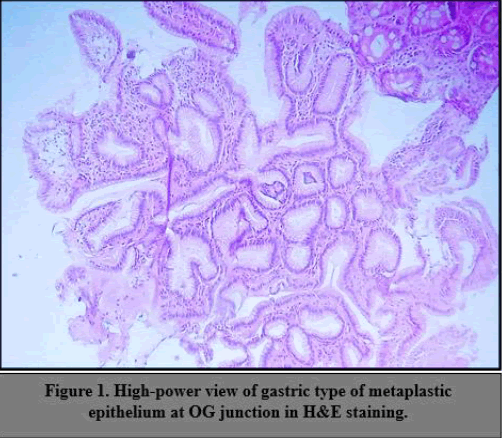
Figure 1. High-power view of gastric type of metaplastic epithelium at OG junction in H&E staining.
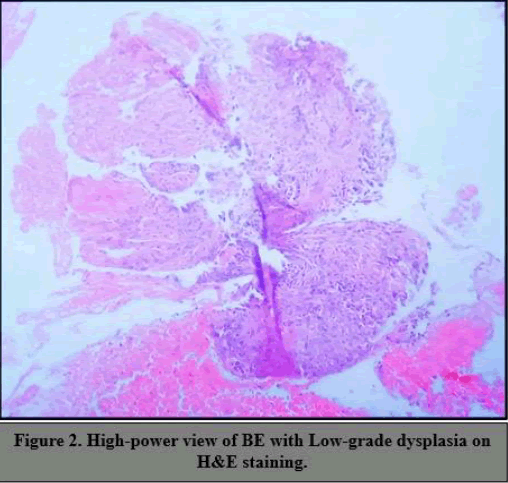
Figure 2. High-power view of BE with Low-grade dysplasia on H&E staining.
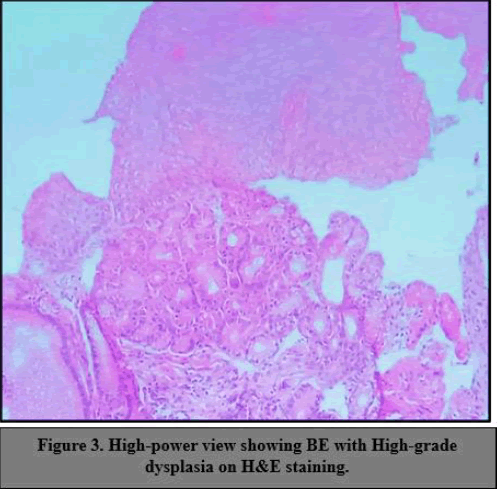
Figure 3. High-power view showing BE with High-gradedysplasia on H&E staining.
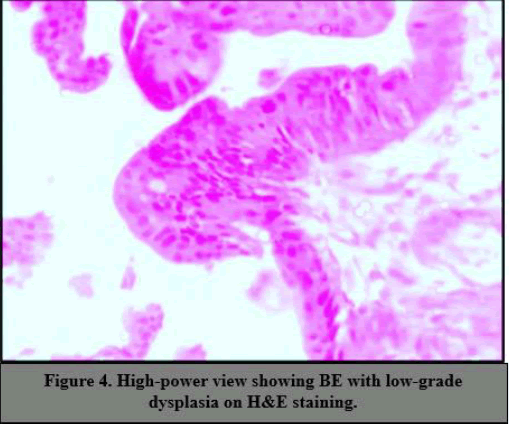
Figure 4. High-power view showing BE with low-grade dysplasia on H&E staining.
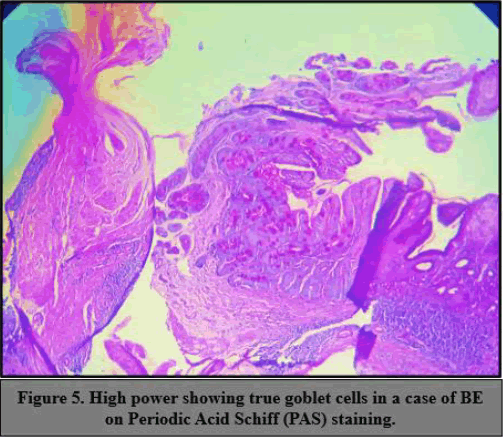
Figure 5. High power showing true goblet cells in a case of BE on Periodic Acid Schiff (PAS) staining.
Norman Barrett first described Barrett’s esophagus in 1950. British Society of Gastroenterology defines BE as “Any distal portion of the squamous epithelial lining of esophagus replaced by metaplastic columnar epithelium which is visible endoscopically and confirmed on biopsy. American Gastroenterological Association (AGA) suggests Intestinal Metaplasia (IM) with goblet cells is required to diagnose BE. The transition from normal squamous esophageal mucosa to stomach columnar mucosa defines the usual Z line that demarcates the squamocolumnar junction. When the Z line is uneven, small tongues of columnar mucosa less than 1 cm long extend into the distal esophagus7.
In our study, the most common age group in BE is 51-60 years, with male preponderance similar to Hvid-Jensen. et al8. Clinically, the majority of BE pases (45%), among which 07 cases exhibited basal cell hyperplasia and congestion with a p-value of <0.005, which is statistically significant. Punia RS et al., reported 53% of cases of esophagitis in their study. One of their cases had associated adenocarcinoma. Low-grade dysplasia was seen in 6 cases (30%) and high-grade dysplasia was seen in 1 case (5%). No cases of adenocarcinoma were seen in the present study9,10.
Hutha, et al. reported 59% of low-grade dysplasia and 33% of high-grade dysplasia. They opined that dysplasia in BE is a progressive lesion and this has a high risk for esophageal adenocarcinoma. In our study, out of 7 cases of dysplasia, 6 cases (85.5%) exhibited intestinal metaplasia and, interestingly, also had features of esophagitis.
Kelty et al., reported 28 cases of adenocarcinoma, which had associated intestinal metaplasia in 17 cases (60%) and they opined that intestinal metaplasia with goblet cells has a higher risk for oesophageal cancer11 (Tables 3 and 4).
| Authors | Age group | Endoscopic findings | ||
| (In years) | ||||
| Punia et.al | 20-40 | Hyperaemia-11 cases (84.6%) | Nodular-01(07%) | Stricture-01 (07%) |
| Hvid-Jensen et.al | 52-72 | Hyperemia-82 cases (82%) | Nodular-16 (16%) | Stricture- 02 (02%) |
| Kambhampati et.al | 65-85 | Hyperemia-15 cases (55%) | Nodular-05 (05%) | Stricture-00 (00%) |
| Our study | 51-60 | Hyperemia-11 cases (55%) | Nodular-01 (05%) | Stricture-01 (05%) |
| Table 3. Comparison of age groups involved and endoscopic findings in Barrett’s esophagus. | ||||
| Authors | Gastric metaplasia | Intestinal metaplasia |
| Punia et.al | 54% | 46% |
| Kelty et.al | 44.92% | 55.08% |
| Gatenby et.al | 34.50% | 65.50% |
| Our study | 55% | 45% |
| Table 4. Comparison of prevalence of type of metaplasia in Barrett’s esophagus. | ||
BE runs an indolent course and is a potent forerunner of malignancy. Hence, endoscopic examination coupled with histopathological examination of altered esophageal mucosa is mandatory for a definitive diagnosis and follow-up up.
[Crossref] [Google Scholar] [PubMed]
[Google Scholar] [PubMed]
[Crossref] [Google Scholar] [PubMed]
[Crossref] [Google Scholar] [PubMed]
[Crossref] [Google Scholar] [PubMed]